Lundy is a narrow island rising from the Bristol Channel about 11 miles north of Hartland Point on the North Devon coast from where it is clearly visible on a fine day:

This evocation of Lundy by the poet Michael Drayton comes from his Poly-Olbion written in 1612. Cantos 4 and 5 of this lengthy work are devoted to Lundy, taking the form of a contest in song between nymphs on either side of the River Severn estuary to determine whether the island should rightly belong to England or to Wales. The poem concludes that she belongs equally to both. In this illustration from the original edition, Neptune and Amphitrite, the Greek sea-goddess, stand on either side of the nymph of Lundy who is adorned with a gannet on her head and has a pair of rabbits at her feet.


The name Lundy is derived from the Old Norse words lundi and ey, meaning 'puffin island'. It was well known to the Viking invaders who harried the coasts of Devon and Wales in the 9th and 10th centuries.
As recently as the 1950's there was a large breeding colony of puffins on the island, but these much loved seabirds were seldom seen in more recent times; indeed the number of breeding pairs had fallen to 10 by 2001. Two reasons were given for this dramatic decline: the predatory action of the black rat population on Lundy, and the commercial fishing for sand eels, the puffin's preferred food. The black rat or Ratus ratus was carried across the world from its native Asia in merchant ships and was widespread and numerous in Britain by Medieval times. Its fleas are believed to be the vector of the Black Death, or bubonic plague, that killed up to one third of the English population in the epidemic of 1348. Since the 18th Century the black rat has been supplanted by the brown rat or Ratus novegicus, and until a recent extermination program was completed Lundy Island's black rat colony was the last in the UK. The elimination of these unlamented rodents from the island offers some hope that puffin numbers may increase in the future.
Progress has been slow, but the latest data is encouraging: fieldwork reported in the Journal of the Lundy Field Society [vol 1, 2008] recorded only four successful breeding pairs out of seven active burrows observed in the summer of 2007, whereas by 2010 the number of breeding pairs had increased to 16, and on June 25th of that year 50 puffins were counted on land at Jenny's Cove. The Lundy puffin colony continues to expand; the most recent survey data of Spring 2013 recorded 80 birds.
There is one seabird that does appear to be thriving now that the island is rat-free. The Manx shearwater, which also rears its chicks in cliff-top burrows on offshore islands, has shown remarkable breeding success on Lundy since the island's rats were eradicated in 2004, with more than 3000 breeding pairs being seen in the Spring of 2013, a tenfold increase over that period.
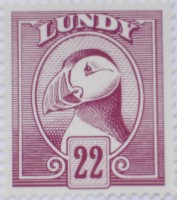
The most commonly seen puffins on the island today are those on the merchandise sold in the island store, including the famous puffin postage stamps first introduced in 1929 by the island's owner, Martin Harman the self-styled King of Lundy. These stamps could be purchased using the Half Puffin and One Puffin coins introduced at the same time. This was in breach of the UK coinage laws, and Puffin coins were withdrawn from circulation after Harman was fined for this infringement.


The island is more than 3 miles long, and averages ½ mile wide; it is longer and narrower than is shown in this map by the 18th century cartographer Donn. At this time Lundy was a parish within part of North Devon known as the Braunton Hundred.
A much more useful map for the modern visitor is this one on which the most prominent features of the island and its coastline are clearly marked. It is reproduced by kind permission of the Lundy Field Society, a charity for the study of Lundy with particular reference to its history, natural history and archaeology, and the conservation of its wildlife and antiquities.


It was during the heatwave of July 1994 that I made my first visit to Lundy. One sultry day as the SS Oldenburg was disappearing from view, ferrying the day-trippers back to the mainland, I made my way slowly along the west coast path northwards from Marisco Castle until I reached the headland high above Jenny's Cove where I sat awhile basking in the late afternoon sun, admiring the spectacular coastline. The silence was broken only by the plaintive cries of the seagulls swooping and gliding to and fro below, and the distant hiss of the sea breaking on the rocks at the foot of the cliffs. The air was fresh and invigorating. On that day this beautiful isle was a haven of tranquillity, but it wasn't always so: it has a history as stormy as the seas that pound its coast through the winter months.
This tale of nefarious goings on is told by Eric R. Delderfield in "The North Devon Story" (1952):

The giant German energy generation company RWE made a formal planning application early in 2013 to build a massive offshore wind farm consisting of 240 772ft turbines in the Bristol Channel north of Lundy which became known as the Atlantic Array. This scheme faced widespread opposition, especially from those concerned by its visual impact on Lundy and the likely adverse effect on its marine environment. The Landmark Trust, the stewards of the island and its holiday properties, lambasted the project saying:

There was a happy ending for the protesters as in November 2013 RWE issued this statement abandoning their planning application, citing the challenging technical issues and current market conditions as reasons for making the project unviable for them.
To mark the 50th anniversary of the Landmark Trust five sculptures by Antony Gormley were erected across the country, one of which was placed on Lundy. This short BBC clip shows Gormley supervising its installation in May 2015. This sculpture was removed from the island in July 2016 at the end of the anniversary period.
